Showing posts with label Subject: Disney Animated Shorts. Show all posts

Clock Cleaners - October 15, 1937


On this day in 1937, the Mickey Mouse cartoon Clock Cleaners was released to theaters across the U.S.A. It is one of the many ‘trio” shorts featuring Mickey, Donald, and Goofy, that were popular during the late 1930s.

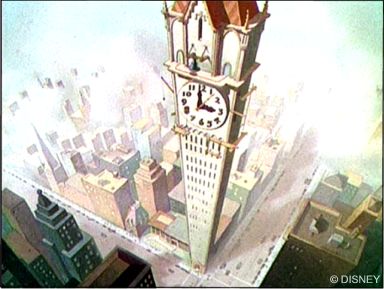
The film places the three protagonists high above the city skyline as they wash and clean both the interior and exterior of an elaborate and precariously high clock tower. It opens with an amazing scene of Mickey riding the clock’s second hand around its face, as a means of cleaning its huge numbers. It then follows each character’s individual adventures: Mickey attempting to evict a stubborn stork; Donald fighting with a sassy mainspring; and Goofy inadvertently being “gonged” by the tower’s mechanical bell-ringers. It climaxes with an intricately choreographed ballet of aerial acrobatics and pratfalls, as Mickey tries to prevent a dumbstruck Goofy from falling to his doom.

Wonderful details abound:The carefully crafted clock face . . .

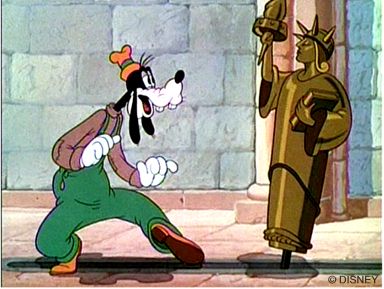
The mechanical bell-ringers that take the forms of Father Time and Miss Liberty . . .

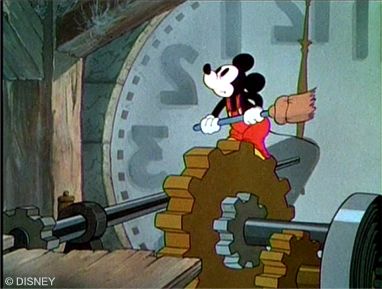
The clock’s intricate gear system that is mechanically accurate and constantly in motion . . .

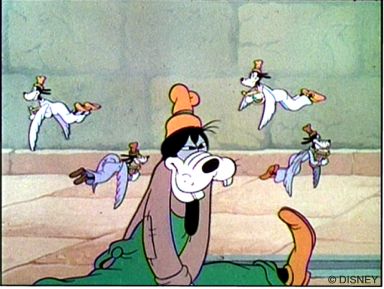
And the little angels that circle Goofy’s head after he is brained by Miss Liberty.

Cured Duck - October 26, 1945


When it comes to our favorite mallard, the title Cured Duck is clearly an oxymoron.

Released on this day in 1945, Cured Duck features Donald Duck attempting to reign in his out-of-control temper so to get back in girlfriend Daisy’s good graces. He responds to a newspaper ad from the Tootsbury Institute of Temperism, and soon finds himself at the mercy of the company’s patented insult machine. The machine guarantees a “cured duck” if Donald can withstand ten minutes of the physical abuse and verbal provocations it dispenses. The duck survives and ultimately displays to Daisy his new powers of self control, only to ironically fall victim to Daisy’s own explosive nature.

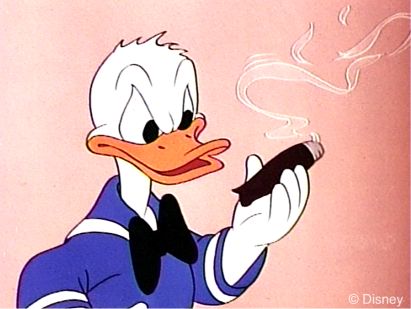
The opening scene is notable in that Donald is puffing away on a large cigar. It was a sequence that was edited out when the short appeared on the Disney Channel’s Vault Disney block of programs in the 1990s. This was at the same time Pecos Bill was having his cigarette digitally erased in the DVD release of Melody Time, and the Martins and the Coys were being extricated from Make Mine Music.

The highlight of Cured Duck is a Donald Duck temper tantrum of epic proportions. After being frustrated by an obviously latched window, he goes on a destructive rampage, of which Daisy’s house is the primary victim. It’s an incredibly rapid sequence of events. Witness when Don rips a telephone from a wall, and then subsequently drags a lamp and washing machine through the plaster as well, followed finally by the phone pole itself:

An interesting bit of 1940s pop culture: when Donald symbolically transforms into a heel after his initial tirade, it bears the Wingfoot brand name.

Out of Scale - November 2, 1951


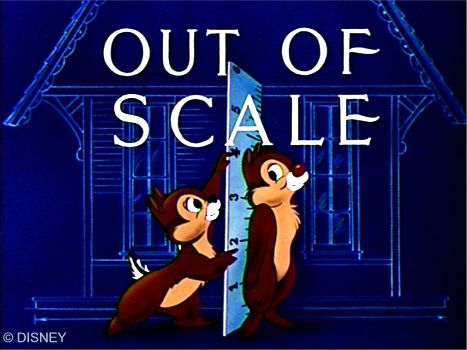
The inspiration for the Donald Duck cartoon Out of Scale, released on this day in 1951, interestingly enough came from Walt Disney himself. Walt had a fascination with trains since he was a young child, so it was not surprising when he took up the hobby of model railroading in the late 1940s. With the help of animators Ward Kimball and Frank Thomas, and the resources of the Disney Studio, Walt built his own backyard railroad, called the Carolwood-Pacific, in the early 1950s. Walt would often don engineer coveralls and cap and take guests on rides on the half mile run around his residential property.


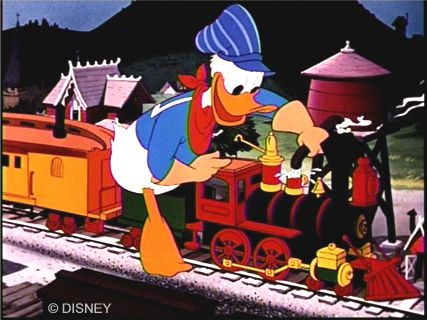
Walt’s exploits quickly became the creative fodder of director Jack Hannah and crew. In the short, Donald is a model train hobbyist, with an extensive garden railway. Insisting that everything in his layout be to the exact scale of his miniature railroad, he unknowingly removes a large tree that is the home of Chip ‘n Dale. The two chipmunks are not very happy about it, and the usual mayhem ensues.


Chip ‘n Dale attempt to rescue their tree, but have to beat a hasty retreat into Don’s miniature town of Canyonville. They quickly become comfortable in a scale model house, that, in a nod to Walt’s concept of the “plausible impossible,” is completely furnished, right down to furniture, food, books, and even reading glasses. It’s possible that the scene might have alluded to Walt’s own penchant for detail--in furnishing the caboose on his 1/8 scale train, he had authentic period newspapers reduced in size and placed in a paper rack.

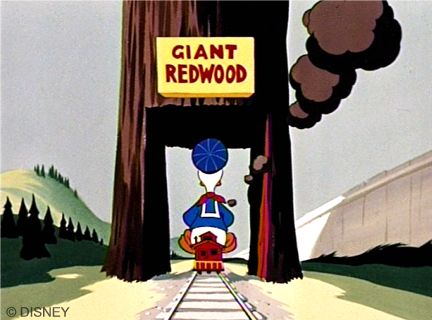
Realizing that the chipmunks are in fact “in scale,” Don calls off the chase and plays along. But the duck can’t resist resorting to some malicious mischief, and the chase resumes anew. In the end, the two convince Donald that their oak tree can convincingly play the part of a giant redwood, and effectively be “in scale.”

How to Be a Detective - December 12, 1952

It begins with a man being violently thrown from a bridge into the icy cold waters of the river below. It ends with a climactic car chase through both urban and rural landscapes. In between, blackjacks are wielded, bullets fly, mickeys are slipped and violence reigns supreme.

It’s a fast paced, hard boiled eight minutes. And oh, did I mention--it’s a Goofy cartoon.

Released on December 12, 1952, How to Be a Detective is without a doubt, one of the best Goofy cartoons ever produced. An over-the-top send up of Hollywood’s dark crime noir genre, it is as irreverent as it is hilarious.

The Goof is cast as Private Eye Johnny Eyeball, who is paid a fast $100 by a “classy dame” to simply “find Al.” He is quickly confronted by Pete in the role of a homicide detective who tries to warn him off the case. He then finds himself consistently at odds with a “suspicious character” who closely resembles one of the weasels from the Wind in the Willows sequence of Icabod and Mr. Toad. Eyeball finds himself subsequently being drugged, machine gunned, fitted with cement shoes and thrown in the river, dropped down an elevator shaft, and kicked out of the morgue (“Beat it! And don’t come back ‘til you’re ready!”)

Comically violent images abound. Take for instance the window actions near the beginning of the short:It’s enough to send a soccer mom on boycotting and letter-writing rampages. Fears of just such actions pretty much kept How to Be a Detective locked up in the vault until its release on the Disney Treasures Complete Goofy DVD a few years ago.

Crazy criminal activity aside, the short sports some outstanding art direction. There are some top notch backgrounds that really evoke the crime film genre that is the target of the cartoon’s humor--

The opening bridge toss:

The eerie, rundown house on the hill:

And the seedy Al’s Joint saloon:

. . . are just a few great examples.

In the end, the case is of course solved, and more by happenstance than by the efforts of Johnny Eyeball. An all around great cartoon and one of the studio's better efforts from the 1950s.

Symposium on Popular Songs - December 19, 1962

Symposium on Popular Songs sits in a relatively unvisited corner of Disney animation history. Rarely seen since its release on this date in 1962, it was finally made available last year on the Walt Disney Treasures Disney Rarities DVD set. It’s interesting for a number of reasons and, and it has some especially notable names in its credits.

Disney’s marketing department released this short article as a part of promotional material sent out to theaters:

With $3.88 worth of groceries, a pipe cleaner, a spool of yarn, a box of toothpicks, 500 sheets of colored paper and their whimsical imaginations, Walt Disney artists Bill Justice and X. Atencio created a symposium of comical characters that make "A Symposium on Popular Songs" one of Disney's funniest featurettes.

The star of the Technicolor production, however, is that expert on everything, the man who invented jazz, Professor Ludwig von Drake. Making his motion picture debut, the Professor introduces a brand new cast of "animoted" stars—made of movable paper cutouts—to trace the history of popular music from ragtime to the twist. Whenever possible, "Pops" von Drake steals the spotlight by sing ing one of the tuneful melodies composed by Richard M. and Robert B. Sherman.

Ludwig's modest home is vaguely reminiscent of the Taj Mahal. He greets his guests at his massive double doors and leads them into the parlor. He explains how, when he was a starving musician at the turn of the century, he was in rags. So he invented ragtime. As the Professor sings and plays "The Rutabaga Rag," a group of "animated" oranges, apples, rutabagas, string beans, and other vegetables and fruits dance the ragtime.

Since ragtime was soon worn to shreds, the Professor decided to write a new song about the roaring twenties. He introduces Betty Boopie Doop to sing "Charleston Charlie," and a group of flapper era characters to do the Charleston.

Ludwig's next great song hit came after he had lost all his money in the depression. To cheer everyone he wrote, "Although I Dropped a Hundred Thousand in the Market, Baby, I Found a Million Dollars in Your Smile." To sing it, the Professor introduces Rah, Rah Rudy and his Megaphone Boys.

During the late 1930's and early 1940's, a new type of singer called "crooners" captured the imaginations of the American public. Ludwig brings on Fosby Crooner to sing his love ballad, "I'm Blue For You, Boo-Bo-Bo-Bo-Boo." Fosby makes it easy for the audience to join in by bouncing from word to word as he sings.

While everyone was cutting "Boo-Boo" records, Ludwig was cutting out paper dolls. By "shear" accident, he cut out three talented look-alikes called the Sister Sisters. The girls introduce the Professor's new boogie woogie rhythm with "The Boogie Woogie Bakery Man." During the 1950's, the beat that put American youth back on its feet was Bop. To sing his new bop hit, "Puppy Love is Here to Stay," Ludwig introduces Freddie Babalon and his Babalpnians.

In his Hi-Fi studio—"Dot means Hi-Finance," says the Professor— von Drake brings his "Symposium on Popular Songs" to a swinging climax by singing and twisting to his latest hit, "Rock, Rumble and Roar."

In color by Technicolor, Walt Disney's cartoon featurette, "A Symposium on Popular Songs," was written and styled by Xavier Atencio, directed by Bill Justice, with words and music by Richard M. and Robert B. Sherman, and arranged and conducted by Tutti Camarata. Animation was by Eric Larson, Cliff Nordberg, Art Stevens, Ward Kimball, Les Clark and Julius Svendsen. Buena Vista releases.

Justice and Atencio previously employed the studio-dubbed “Animotion” stop motion animation process on the 1959 release Noah’s Ark, and in a number of opening title sequences of live action features, most notably The Parent Trap in 1961. Both Noah’s Ark and Symposium earned Oscar nominations. The results of the process in Symposium are both clever and creative, but can be a shock to those expecting traditional hand-drawn, cel-produced Disney animation.

The music and lyrics by the Sherman Brothers are a lot of fun, but sadly have been largely forgotten, even by the Disney company itself. I’ve only come across one song, “Although I Dropped a Hundred Thousand in the Market, Baby, I Found a Million Dollars in Your Smile,” on a CD compilation. Surprisingly, The Sherman Brothers CD that the company released back in 1992, did not include any of the seven numbers from Symposium.

The highlight of Symposium on Popular Songs for me personally is Ludwig Von Drake, as performed by Paul Frees. Von Drake is one of the most underrated of all Disney characters. He is nothing short of hilarious in all of his appearances, of which Symposium is no exception. An especially great example of Frees’ voice and comedic talent with Von Drake is the vintage 1961 vinyl LP Professor Ludwig Von Drake, which has been recently made available for download on iTunes.

Likely one of the reasons Symposium remained locked away, especially in recent years, was a fairly extreme caricature of a Chinese character in the Boogie Woogie Bakery Man sequence. Thankfully, Disney has moved away from the soccer-mom focus group method of marketing its classic animation, and now allows viewers to evaluate these films, and their occasional controversial elements, for themselves.

The Worm Turns - January 2, 1937

Released on this day in 1937, the Mickey Mouse short The Worm Turns is an exercise in clever cartoon action and gags, gorgeous watercolor backgrounds and brilliant Technicolor. Made in the late 1930s days of the Hyperion Avenue studio, it is a shining example of the outstanding art direction that was a hallmark of much of Disney’s output at that time.

Had Universal’s classic Frankenstein movies been made in Technicolor, the opening sequence from The Worm Turns might give you an idea of how they would have looked. Director Ben Sharpsteen and his crew are clearly paying homage to the good doctor when Mickey, in his white lab coat and red shiny rubber gloves, mixes a vibrant and excitable batch of chemicals.

The object of Mickey’s experimenting is to concoct a bravery potion. The ingredients he mixes together are beautifully staged via two wonderful background paintings:

The details are terrific. For example, the recipe for the Courage Builder is quite detailed, and comes from and old bound tome entitled Ancient formulae.

As the cartoon progresses, Mickey takes on more of a supporting role as he tests his courage-inducing potion on a fly, mouse, cat, and ultimately Pluto. Showdowns build one upon another, leading up to Pluto’s confrontation with a shotgun wielding dogcatcher, played to villainous extreme by Pete.

There are so many standout moments in The Worm Turns; it is truly difficult to name them all. I particularly like the bird’s eye camera shot of Mickey about to dose the mouse:

The clever gag of the cat’s nine lives exit, and then subsequent return, to their host. It is especially funny when Life #1 emerges, and then whistles for #2-9 to follow.

There is also Pluto’s squash and stretch encounter with a brick wall. (Check the wonderful details--the NO PARKING crosswalk and the patched flat tire on Pete’s wagon.)

And the neighborhood backdrop to the Pete-Pluto chase is beautiful:

The film has one interesting continuity error. Near the beginning when Mickey removes a cork from a potion bottle with his mouth, it mysteriously disappears a few frames later.

The Worm Turns is among many other notable Disney shorts from the same time period, on the DVD set Mickey Mouse In Living Color Volume One.

A quick postscript: In my research, I was unable to track down any credits beyond director Ben Sharpsteen and animator Al Eugster. If anyone knows who was responsible for this short's amazing backgrounds, please put a post in the comments section. Thanks!

Animated Animators - The Nifty Nineties

The 1941 Mickey Mouse cartoon The Nifty Nineties makes subtle, and not so subtle references to numerous Disney Studio staffers of the time period. Now famous animator/writer/producer/director and Nine Old Men alumnus Ward Kimball literally takes center stage with fellow animator Fred Moore in the short’s vaudeville show sequence.

As “Fred and Ward-Two Clever Boys from Illinois,” the two tell jokes and perform pratfalls for an audience that includes Mickey and Minnie. According to an animators draft provided by Jenny Lerew to Mark Mayerson for his Mayerson on Animation blog, Kimball in fact animated himself and Moore in the sequence.


The Nifty Nineties references other studio personnel in the same scene via a number of advertisements on the theater’s curtain.


Walter D.’s Hats That Please -- Okay, that one’s pretty obvious.

Wilfred Jaxon Feed and Fuel -- Veteran animation director Wilfred Jackson.

Riley’s Livery Stable -- Nifty Nineties director Riley Thompson.

Prof. Churchill Pianos Tuned -- Composer Frank Churchill.

Clark’s Confectionary -- Animator Les Clark.

Gen. J. Sharpsteen Dentist -- Studio veteran Ben Sharpsteen.

R. B. Martch Guns -- Animator Bob Martch

T. Hee Shoes -- Storyman T. Hee.

Happy Herb Undertaker, Palms Read - C. Payzant, M. Flanigan Coffee, M. Nelson Fancy Goods, and Breezy Allen’s Haberdashery are the other ads on the curtain. So far in my research, I haven’t found anyone who has been able to identify any individuals associated with those particular names.

[EDIT: Jeff Kurtti provided some additional identifications via the comments section that I wanted to include here as well:

Charles Payzant was a watercolor artist who served as art director on the Night on Bald Mountain segment of Fantasia and on Dumbo. Happy Herb may refer to Herb Ryman, who was an art director on the Pastoral Symphony segment of Fantasia and on Dumbo. Mary Flanigan ran a coffee and snack shop at Hyperion and then at the Burbank Studio.

Thanks Jeff!]

[EDIT #2: Are Myklebust provided some corrections to to my transcribing (from a blurry screen capture) which I have made, and also provided the following identifications:

M. Nelson Fancy Goods -- background artist Myron F. Nelson.

"Breezy" Allen's Haberdashery -- animator Paul Allen.

And one ad I did not previously list:

C.E. Philippi Fishing Eqpt. -- layout artist Charles Phillipi.

Thanks Are!]

In a comment on Mark Mayerson’s aforementioned post about The Nifty Nineties, Michael Barrier identified the drunk man in the “Father Dear Father” part of the vaudeville show as a caricature of company vet Dick Huemer.

It's Tough to Be a Buzzard from Hinckley Ridge

With the month of March now upon us, we are reminded that the buzzards will soon be returning to roost in the small town of Hinckley, Ohio. The tradition of welcoming these turkey vultures back to their summer habitats was established in 1957, and to most of the area’s residents, it signifies the true arrival of spring.

But to Disney enthusiasts of the baby boomer generation, it serves to remind us of a once famous, but now mostly obscure Disney production. For the story of Hinckley and its prodigal buzzards became perhaps the most well remembered element of the 1969 animated short subject It’s Tough to Be a Bird, and the subsequent episode it evolved into on the Wonderful World of Disney in 1970.

Now I can only speak from my own memories, but this wacky film was a huge deal to myself and fellow members of my then preteen generation. While my contemporaries viewed most Disney television offerings of the time as little more than a way to kill an hour on a Sunday evening, It’s Tough to Be a Bird managed to elevate itself to a viewing status typically reserved for the likes of The Wizard of Oz and holiday perennials Rudolph the Red-Nosed Reindeer and A Charlie Brown Christmas. It was the subject of at least a couple Monday morning playground discussions that I fondly remember participating in.

Released on December 10, 1969, It’s Tough to Be a Bird proved immensely popular due largely in part to its zany, fast paced montages and over-the-top humor. It was all a very distinct reflection of its creator Ward Kimball. The film is hosted by the character M.C. Bird, voiced by Richard Bakalyan, who relates (often to his own detriment) the history of mankind’s relationship with its avian counterparts. While rooted in some of Kimball’s sci-fi themed parodies from earlier Disney anthology episodes, it is clearly a departure from the studio’s typical short subject fare, animated or otherwise. Its offbeat nature is more akin to Monty Python than Mickey Mouse, and its cutout style animation brings to mind the later efforts of Terry Gilliam on the Pythons’ Flying Circus shows. In one particular scene that epitomizes the film’s somewhat more irreverent humor, M.C. alludes to Edgar Allen Poe’s reputed alcoholism and how a certain raven salvaged his literary career.

The short culminates with the aforementioned visit to Hinckley, Ohio, and the very quirky reality of the town’s “Buzzard Day” celebrations. The sequence finishes with comedienne Ruth Buzzi’s hilarious and very off-key rendition of “When the Buzzards Return to Hinckley Ridge.” Kimball’s efforts were rewarded when the film received the Academy Award for Best Cartoon Short Subject of 1969.

Originally 22 minutes in length, the short was expanded to fill out a full episode of the Wonderful World of Disney that first aired in December of 1970. Recycled True-Life Adventure footage and a homage to birds in Disney films and cartoons rounded out the television version.

The film’s success would lead Kimball to direct Dad, Can I Borrow the Car, another short similar in style and humor, but this time examining the relationship between man and the automobile. Narrated by Kurt Russell, it arrived in theaters in September of 1970.

Unfortunately, watching either version of It’s Tough to Be a Bird, is quite difficult at best. The theatrical version appeared a few times on Disney Channel Vault Disney programming in the late 1990s. I was lucky to obtain a copy of the television version when it was included on a Wonderful World of Disney VHS collection, and that tape is now well over twenty years old. Hope currently rests on its possible inclusion in a future Treasures or Legacy DVD set of remaining Disney rarities.

Those Complicated Funny Little Bunnies

With Easter fast approaching, Disney’s Funny Little Bunnies was clearly an obvious choice for the subject of a post here at 2719 Hyperion.

When I watched the 1934 cartoon short recently, I saw a quaint, entertaining, but largely unspectacular endeavor from Disney’s prolific and groundbreaking Hyperion era. The film was the only Easter-themed short produced by Disney and stands as a shining example of the studio’s early marriage with three-color Technicolor. Like numerous other Silly Symphonies, it is a generally plot-less affair, a series of gags and vignettes that served to explain the more secular traditions associated with the Easter holiday. Similar in theme, style and structure to the earlier Santa’s Workshop, the short features a happy contingent of well-dressed rabbits and their assembly line antics, producing holiday treats such as decorated eggs and chocolate bunnies.

So, how could I take a fresh look at this 70+ year old cartoon?

There was the possibility of merchandise tie-ins. But alas, I’m not much of a vintage Disneyana collector and references to products relating to the more obscure Silly Symphonies are a bit difficult to track down. But there was one interesting item that bore mentioning--a 1951 Little Golden Book entitled Grandpa Bunny, that nearly two decades after the cartoon’s release, explained the origins of Bunnyville and its founder Great Grandpa Bunny Bunny.

Then there was the angle of Wolfgang Reitherman, one of Disney’s famous “Nine Old Men.” It had been noted that Funny Little Bunnies was likely Reitherman’s first assignment at the Disney Studio. I immediately went scrambling for Didier Ghez’s Walt’s People books and dug back into the series’ one Reitherman interview. But there was only a brief mention of the short where the studio veteran noted some difficulty in animating the decorated eggs in a couple of scenes.

My Disney history muse was clearly letting me down.

But sometimes an academic approach is not always the correct one. And it was my own mother who indirectly reminded me of this fact.

She was with me when I popped the DVD in the player a second time and navigated through the menu screens to Funny Little Bunnies, desperately seeking some measure of inspiration.

Within a few moments after the short started, my mom observed, “This is old, like one of the cartoons I would have watched when I was a little girl.” I confirmed that she would have been a child of five years when Funny Little Bunnies was released. She continued to watch for a few moments, then added, “Cartoons were good back then. Not like now. I don’t understand the cartoons that come out now.” As a grandmother of toddlers and tweens, she was likely referring to antics of Sponge Bob, Kim Possible and the countless other animated denizens that travel the current cable and satellite signals.

Talk about a humbling moment. Mom’s very basic observation was the perspective I needed. I was over complicating a bunch of cute rabbits.

Because Funny Little Bunnies, like so many of its Silly Symphony contemporaries, is engaging in its very simplicity. In a funny, colorful and happy manner, it explained to a generation of Depression-era children, just where Easter baskets came from.

Disney enthusiasts such as myself frequently expound on the child-like wonder that Disney entertainment often restores to our jaded and cynical adult frames of reference. Yet very often we can’t see the enchanted forest for the trees. Sometimes a work of animation needs to be perceived as it had been by its original audience, without any baggage of historical perspective. To its audience of some seven decades ago, Funny Little Bunnies was a simple and entertaining eight minutes of cartoon fun.
The Simple Things - April 18, 1953

The 1953 Mickey Mouse cartoon The Simple Things is an average and in almost all ways unremarkable production. But what it has come to represent, at least to me personally, resonates on an emotional and sentimental level that goes beyond anything the actual short itself conveys.

The Simple Things certainly lives up to its title. Mickey and Pluto take a fishing trip to the beach where their primary antagonists are a persistent clam and overly annoying seagull. It follows the typical pattern of multi-character shorts, where each character has a separate vignette (Pluto with the clam; Mickey with the gull) and then reunite for an overall climax.

But what distinguishes The Simple Things, was that for all intents and purposes, it was essentially the last Mickey Mouse cartoon.

Granted, Mickey’s Christmas Carol would be produced in 1983, and would be followed seven years later by the Prince and the Pauper. But they were both special productions-- adaptations of literary works with more extended running times, and were not really akin to the typical 7-8 minute shorts produced during the studio’s first three decades. And while Runaway Brain certainly matched the just described criteria for classification as a cartoon short, the 1995 film stands more as a happy and refreshing anomaly rather that a return to a schedule of studio produced fare.

No, despite these films and even the television-produced Mickey’s MouseWorks and House of Mouse, The Simple Things represented Mickey’s retirement from the very art form that he as a character ultimately defined and revolutionized. It would also foreshadow Walt Disney’s own shuttering of the studio’s shorts department two years later in 1955.

Mickey’s retirement from film did not relegate him to the life of leisure embodied in the carefree fishing trip of The Simple Things. He quickly transitioned into a television personality via the Mickey Mouse Club and appearances on the Disney anthology program, and later into the roles of theme park ambassador and corporate icon. But he would with his costars--Donald, Pluto, and Goofy among others--leave behind the very form of entertainment that in fact had given birth to the Walt Disney Company.

I can’t imagine that director Charles Nichols and his crew ever intended for the title of The Simple Things to imply anything beyond the cartoon’s theme and content. But in my studies and research of the short, it has always been identified as Mickey’s last cartoon and in that context the title has always taken on an additional meaning for me. The song "The Simple Things" that opens and closes the film, provides more than a moment of bittersweet sentimentality when considered in the context of the then declining animated short subject, not just at Disney but across the rest of Hollywood as well.

The theatrical cartoons of 1930s, 1940s and 1950s are in many ways the simple things referenced by that song’s lyrics. As Mickey and Pluto no doubt journeyed to a rocky beach to escape their worries and troubles in The Simple Things, I and countless others still escape in a similar fashion to that simpler, yet always endearing animated entertainment of those bygone days.
For seven brief minutes in 1929, Mickey Mouse was, at least in physical size, a mouse.
It has always been a point of amusement that Mickey is, well . . . pretty big for a mouse. When viewed in scale to his surroundings, Mickey likely stands three to four feet tall; a little guy in the conventional sense, but one pretty hefty rodent otherwise. Many toddlers are often sent into screaming hysterics when they encounter for the first time Mickey’s even larger theme park incarnation.

That is why the 1929 cartoon When the Cat’s Away, Mickey’s sixth film, stands as a curious anomaly in the iconic character’s long filmography. For in both physical size and social dynamic, Mickey is truly a mouse in this Walt Disney directed short.

Like many of its early Mickey Mouse and Silly Symphony counterparts, When the Cat’s Away is a music-based collection of pratfalls and gags centered on a simple premise and void of any kind of plot. Its raw barnyard pedigree is evident right from the start, when the title-referenced character of Tom Cat emerges from a run down shack and quickly imbibes in a triple-X branded jug of moonshine before making his required exit. To the uninitiated, when Mickey pops out of the small hole in Tom’s porch moments later and subsequently leads a small army of mice into the shack, the short takes on an unintended surreal quality.

It is no small coincidence that the Mickey’s fellow mice bear striking resemblances to similar rodents from Disney’s earlier silent endeavors. The film is a remake of sorts of Alice Rattled by Rats, produced in 1925, and the character designs do not stray far from that short’s original cast. And these “supporting mice” contribute much of the cartoon’s content. Mickey’s antics are for the most part focused on a player piano and the typical cartoon gags that that instrument usually inspires. While somewhat mundane overall, the film’s shortcomings are easily forgiven in relation to its more relevant historical context.

But more than anything, When the Cat’s Away is fascinating simply on the level of watching Mickey engage in an environment that matches the creature that he is. In that regard, the cartoon is a curious left turn away from the five Mickey Mouse shorts that preceded it. Mickey had been clearly established as an out-of-scale mouse from his inception in Plane Crazy. For whatever reason, in this case premise trumped consistency and Mickey enjoyed a brief connection with his more primal (albeit still in a cartoon sense) nature.

I can think of only one other screen appearance where Mickey was distinctly “mouse scale”--the 1934 film Hollywood Party. This early live action-animation mix has comedian Jimmy Durante at one point picking Mickey up by the tail while party-goers scream and stand on tables and chairs. Check this earlier post for more information on that particular Disney-MGM collaboration.

And on one final note regarding When the Cat’s Away—the frequent off-color humor prevalent in many of these early shorts is markedly apparent at the cartoon’s end. Minnie’s own “end” becomes prominent in one of the film’s parting shorts.

Mickey's Mechanical Man - June 17, 1933

Here’s an interesting quote from Walt Disney:

“The robot angle is popular now. There have been several robots made that really do perform things, and the public is aware of the possibility of the thing.”

Is he referencing the now-famous Buddy Ebsen “little man” experiment? Or discussing the advent of audio animatronics as ultimately realized by such milestones as Great Moments with Mister Lincoln or Pirates of the Caribbean?

No, these words predate even those events by quite a number of years. They were written in January of 1933 as Walt put to paper his ideas for a cartoon short that would ultimately take the form of Mickey’s Mechanical Man, released on June 17 of that same year.

The cartoon was an odd and decidedly offbeat entry in the still clearly evolving Mickey Mouse series. As Walt noted, a fascination with robots and mechanical men was gradually emerging in Depression-era popular culture and it would reach a crescendo of sorts with Westinghouse’s introduction of Elektro the Robot at the 1939 New York World’s Fair. But while Mickey’s automaton marvel is certainly inspired by representations of robots in the science fiction pulp magazines of the era, the cartoon’s story and setting are much more pedestrian and decidedly non-“fantastic” in nature. For Sam, as Mickey named his mechanical wonder, is not destined for the amazing adventures experienced by his magazine and Hollywood counterparts, but was created in fact for a slightly less inspired function: boxing.

Sam’s adversary in the ring took its cue from another popular archetype of the period, a savage and menacing gorilla. Likely the short’s creative talent were aware of the impending April 1933 release of Merian C. Cooper’s King Kong, as the story’s boxing simian just happened to be named The Kongo Killer.

The story’s action and humor center on the literally one-note gag of Minnie’s car horn that sends Sam into a frenzied, out-of-control rage. It is ultimately that gimmick that empowers Sam to defeat his rival. In a fast paced sequence, boxing glove-donned arms and apertures rapidly and successively emerge from all over Sam’s body and pummel Kongo into submission.

While Walt’s original notes detailed scenes of Mickey actually building Sam and subsequently operating him by remote control, the finished short provides no apparent explanation of the robot’s origin, and he acts relatively autonomous from his mentor. Without this background, the cartoon takes on an almost matter-of-fact attitude towards its somewhat wacky premise, as if robot-gorilla matchups were common events during those early years of the Great Depression. But as in many of Mickey’s early black and white efforts, it’s the occasionally off the wall and weird ideas such as those realized in Mickey’s Mechanical Man that became many of the mouse’s more memorable moments.

In the end what I enjoy the most about this particular short is the simple tin can-style design of Sam and how it epitomized those early steam-powered, gear-filled representations of mechanical men. Cartoons are very often snapshots of popular culture, and Mickey’s Mechanical Man presented us with an early rendition of what would become a major icon of science fiction-themed entertainment.


Special thanks to Hans Perk who made available Walt’s original notes for Mickey’s Mechanical Man on his website A. Film L.A.