Showing posts with label Cartoon Star: Mickey Mouse. Show all posts

Clock Cleaners - October 15, 1937


On this day in 1937, the Mickey Mouse cartoon Clock Cleaners was released to theaters across the U.S.A. It is one of the many ‘trio” shorts featuring Mickey, Donald, and Goofy, that were popular during the late 1930s.

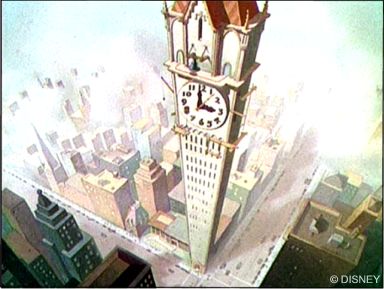
The film places the three protagonists high above the city skyline as they wash and clean both the interior and exterior of an elaborate and precariously high clock tower. It opens with an amazing scene of Mickey riding the clock’s second hand around its face, as a means of cleaning its huge numbers. It then follows each character’s individual adventures: Mickey attempting to evict a stubborn stork; Donald fighting with a sassy mainspring; and Goofy inadvertently being “gonged” by the tower’s mechanical bell-ringers. It climaxes with an intricately choreographed ballet of aerial acrobatics and pratfalls, as Mickey tries to prevent a dumbstruck Goofy from falling to his doom.

Wonderful details abound:The carefully crafted clock face . . .

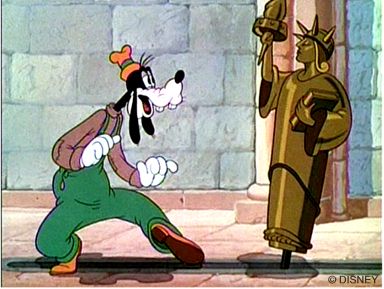
The mechanical bell-ringers that take the forms of Father Time and Miss Liberty . . .

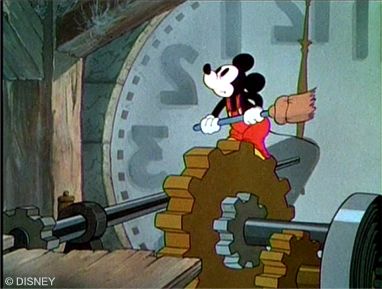
The clock’s intricate gear system that is mechanically accurate and constantly in motion . . .

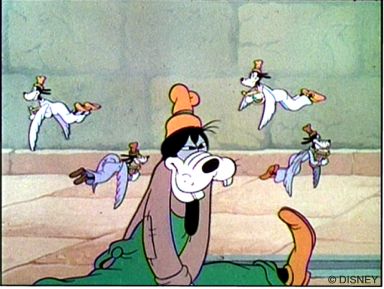
And the little angels that circle Goofy’s head after he is brained by Miss Liberty.

The Worm Turns - January 2, 1937

Released on this day in 1937, the Mickey Mouse short The Worm Turns is an exercise in clever cartoon action and gags, gorgeous watercolor backgrounds and brilliant Technicolor. Made in the late 1930s days of the Hyperion Avenue studio, it is a shining example of the outstanding art direction that was a hallmark of much of Disney’s output at that time.

Had Universal’s classic Frankenstein movies been made in Technicolor, the opening sequence from The Worm Turns might give you an idea of how they would have looked. Director Ben Sharpsteen and his crew are clearly paying homage to the good doctor when Mickey, in his white lab coat and red shiny rubber gloves, mixes a vibrant and excitable batch of chemicals.

The object of Mickey’s experimenting is to concoct a bravery potion. The ingredients he mixes together are beautifully staged via two wonderful background paintings:

The details are terrific. For example, the recipe for the Courage Builder is quite detailed, and comes from and old bound tome entitled Ancient formulae.

As the cartoon progresses, Mickey takes on more of a supporting role as he tests his courage-inducing potion on a fly, mouse, cat, and ultimately Pluto. Showdowns build one upon another, leading up to Pluto’s confrontation with a shotgun wielding dogcatcher, played to villainous extreme by Pete.

There are so many standout moments in The Worm Turns; it is truly difficult to name them all. I particularly like the bird’s eye camera shot of Mickey about to dose the mouse:

The clever gag of the cat’s nine lives exit, and then subsequent return, to their host. It is especially funny when Life #1 emerges, and then whistles for #2-9 to follow.

There is also Pluto’s squash and stretch encounter with a brick wall. (Check the wonderful details--the NO PARKING crosswalk and the patched flat tire on Pete’s wagon.)

And the neighborhood backdrop to the Pete-Pluto chase is beautiful:

The film has one interesting continuity error. Near the beginning when Mickey removes a cork from a potion bottle with his mouth, it mysteriously disappears a few frames later.

The Worm Turns is among many other notable Disney shorts from the same time period, on the DVD set Mickey Mouse In Living Color Volume One.

A quick postscript: In my research, I was unable to track down any credits beyond director Ben Sharpsteen and animator Al Eugster. If anyone knows who was responsible for this short's amazing backgrounds, please put a post in the comments section. Thanks!

Animated Animators - The Nifty Nineties

The 1941 Mickey Mouse cartoon The Nifty Nineties makes subtle, and not so subtle references to numerous Disney Studio staffers of the time period. Now famous animator/writer/producer/director and Nine Old Men alumnus Ward Kimball literally takes center stage with fellow animator Fred Moore in the short’s vaudeville show sequence.

As “Fred and Ward-Two Clever Boys from Illinois,” the two tell jokes and perform pratfalls for an audience that includes Mickey and Minnie. According to an animators draft provided by Jenny Lerew to Mark Mayerson for his Mayerson on Animation blog, Kimball in fact animated himself and Moore in the sequence.


The Nifty Nineties references other studio personnel in the same scene via a number of advertisements on the theater’s curtain.


Walter D.’s Hats That Please -- Okay, that one’s pretty obvious.

Wilfred Jaxon Feed and Fuel -- Veteran animation director Wilfred Jackson.

Riley’s Livery Stable -- Nifty Nineties director Riley Thompson.

Prof. Churchill Pianos Tuned -- Composer Frank Churchill.

Clark’s Confectionary -- Animator Les Clark.

Gen. J. Sharpsteen Dentist -- Studio veteran Ben Sharpsteen.

R. B. Martch Guns -- Animator Bob Martch

T. Hee Shoes -- Storyman T. Hee.

Happy Herb Undertaker, Palms Read - C. Payzant, M. Flanigan Coffee, M. Nelson Fancy Goods, and Breezy Allen’s Haberdashery are the other ads on the curtain. So far in my research, I haven’t found anyone who has been able to identify any individuals associated with those particular names.

[EDIT: Jeff Kurtti provided some additional identifications via the comments section that I wanted to include here as well:

Charles Payzant was a watercolor artist who served as art director on the Night on Bald Mountain segment of Fantasia and on Dumbo. Happy Herb may refer to Herb Ryman, who was an art director on the Pastoral Symphony segment of Fantasia and on Dumbo. Mary Flanigan ran a coffee and snack shop at Hyperion and then at the Burbank Studio.

Thanks Jeff!]

[EDIT #2: Are Myklebust provided some corrections to to my transcribing (from a blurry screen capture) which I have made, and also provided the following identifications:

M. Nelson Fancy Goods -- background artist Myron F. Nelson.

"Breezy" Allen's Haberdashery -- animator Paul Allen.

And one ad I did not previously list:

C.E. Philippi Fishing Eqpt. -- layout artist Charles Phillipi.

Thanks Are!]

In a comment on Mark Mayerson’s aforementioned post about The Nifty Nineties, Michael Barrier identified the drunk man in the “Father Dear Father” part of the vaudeville show as a caricature of company vet Dick Huemer.

The Simple Things - April 18, 1953

The 1953 Mickey Mouse cartoon The Simple Things is an average and in almost all ways unremarkable production. But what it has come to represent, at least to me personally, resonates on an emotional and sentimental level that goes beyond anything the actual short itself conveys.

The Simple Things certainly lives up to its title. Mickey and Pluto take a fishing trip to the beach where their primary antagonists are a persistent clam and overly annoying seagull. It follows the typical pattern of multi-character shorts, where each character has a separate vignette (Pluto with the clam; Mickey with the gull) and then reunite for an overall climax.

But what distinguishes The Simple Things, was that for all intents and purposes, it was essentially the last Mickey Mouse cartoon.

Granted, Mickey’s Christmas Carol would be produced in 1983, and would be followed seven years later by the Prince and the Pauper. But they were both special productions-- adaptations of literary works with more extended running times, and were not really akin to the typical 7-8 minute shorts produced during the studio’s first three decades. And while Runaway Brain certainly matched the just described criteria for classification as a cartoon short, the 1995 film stands more as a happy and refreshing anomaly rather that a return to a schedule of studio produced fare.

No, despite these films and even the television-produced Mickey’s MouseWorks and House of Mouse, The Simple Things represented Mickey’s retirement from the very art form that he as a character ultimately defined and revolutionized. It would also foreshadow Walt Disney’s own shuttering of the studio’s shorts department two years later in 1955.

Mickey’s retirement from film did not relegate him to the life of leisure embodied in the carefree fishing trip of The Simple Things. He quickly transitioned into a television personality via the Mickey Mouse Club and appearances on the Disney anthology program, and later into the roles of theme park ambassador and corporate icon. But he would with his costars--Donald, Pluto, and Goofy among others--leave behind the very form of entertainment that in fact had given birth to the Walt Disney Company.

I can’t imagine that director Charles Nichols and his crew ever intended for the title of The Simple Things to imply anything beyond the cartoon’s theme and content. But in my studies and research of the short, it has always been identified as Mickey’s last cartoon and in that context the title has always taken on an additional meaning for me. The song "The Simple Things" that opens and closes the film, provides more than a moment of bittersweet sentimentality when considered in the context of the then declining animated short subject, not just at Disney but across the rest of Hollywood as well.

The theatrical cartoons of 1930s, 1940s and 1950s are in many ways the simple things referenced by that song’s lyrics. As Mickey and Pluto no doubt journeyed to a rocky beach to escape their worries and troubles in The Simple Things, I and countless others still escape in a similar fashion to that simpler, yet always endearing animated entertainment of those bygone days.
For seven brief minutes in 1929, Mickey Mouse was, at least in physical size, a mouse.
It has always been a point of amusement that Mickey is, well . . . pretty big for a mouse. When viewed in scale to his surroundings, Mickey likely stands three to four feet tall; a little guy in the conventional sense, but one pretty hefty rodent otherwise. Many toddlers are often sent into screaming hysterics when they encounter for the first time Mickey’s even larger theme park incarnation.

That is why the 1929 cartoon When the Cat’s Away, Mickey’s sixth film, stands as a curious anomaly in the iconic character’s long filmography. For in both physical size and social dynamic, Mickey is truly a mouse in this Walt Disney directed short.

Like many of its early Mickey Mouse and Silly Symphony counterparts, When the Cat’s Away is a music-based collection of pratfalls and gags centered on a simple premise and void of any kind of plot. Its raw barnyard pedigree is evident right from the start, when the title-referenced character of Tom Cat emerges from a run down shack and quickly imbibes in a triple-X branded jug of moonshine before making his required exit. To the uninitiated, when Mickey pops out of the small hole in Tom’s porch moments later and subsequently leads a small army of mice into the shack, the short takes on an unintended surreal quality.

It is no small coincidence that the Mickey’s fellow mice bear striking resemblances to similar rodents from Disney’s earlier silent endeavors. The film is a remake of sorts of Alice Rattled by Rats, produced in 1925, and the character designs do not stray far from that short’s original cast. And these “supporting mice” contribute much of the cartoon’s content. Mickey’s antics are for the most part focused on a player piano and the typical cartoon gags that that instrument usually inspires. While somewhat mundane overall, the film’s shortcomings are easily forgiven in relation to its more relevant historical context.

But more than anything, When the Cat’s Away is fascinating simply on the level of watching Mickey engage in an environment that matches the creature that he is. In that regard, the cartoon is a curious left turn away from the five Mickey Mouse shorts that preceded it. Mickey had been clearly established as an out-of-scale mouse from his inception in Plane Crazy. For whatever reason, in this case premise trumped consistency and Mickey enjoyed a brief connection with his more primal (albeit still in a cartoon sense) nature.

I can think of only one other screen appearance where Mickey was distinctly “mouse scale”--the 1934 film Hollywood Party. This early live action-animation mix has comedian Jimmy Durante at one point picking Mickey up by the tail while party-goers scream and stand on tables and chairs. Check this earlier post for more information on that particular Disney-MGM collaboration.

And on one final note regarding When the Cat’s Away—the frequent off-color humor prevalent in many of these early shorts is markedly apparent at the cartoon’s end. Minnie’s own “end” becomes prominent in one of the film’s parting shorts.

Mickey's Mechanical Man - June 17, 1933

Here’s an interesting quote from Walt Disney:

“The robot angle is popular now. There have been several robots made that really do perform things, and the public is aware of the possibility of the thing.”

Is he referencing the now-famous Buddy Ebsen “little man” experiment? Or discussing the advent of audio animatronics as ultimately realized by such milestones as Great Moments with Mister Lincoln or Pirates of the Caribbean?

No, these words predate even those events by quite a number of years. They were written in January of 1933 as Walt put to paper his ideas for a cartoon short that would ultimately take the form of Mickey’s Mechanical Man, released on June 17 of that same year.

The cartoon was an odd and decidedly offbeat entry in the still clearly evolving Mickey Mouse series. As Walt noted, a fascination with robots and mechanical men was gradually emerging in Depression-era popular culture and it would reach a crescendo of sorts with Westinghouse’s introduction of Elektro the Robot at the 1939 New York World’s Fair. But while Mickey’s automaton marvel is certainly inspired by representations of robots in the science fiction pulp magazines of the era, the cartoon’s story and setting are much more pedestrian and decidedly non-“fantastic” in nature. For Sam, as Mickey named his mechanical wonder, is not destined for the amazing adventures experienced by his magazine and Hollywood counterparts, but was created in fact for a slightly less inspired function: boxing.

Sam’s adversary in the ring took its cue from another popular archetype of the period, a savage and menacing gorilla. Likely the short’s creative talent were aware of the impending April 1933 release of Merian C. Cooper’s King Kong, as the story’s boxing simian just happened to be named The Kongo Killer.

The story’s action and humor center on the literally one-note gag of Minnie’s car horn that sends Sam into a frenzied, out-of-control rage. It is ultimately that gimmick that empowers Sam to defeat his rival. In a fast paced sequence, boxing glove-donned arms and apertures rapidly and successively emerge from all over Sam’s body and pummel Kongo into submission.

While Walt’s original notes detailed scenes of Mickey actually building Sam and subsequently operating him by remote control, the finished short provides no apparent explanation of the robot’s origin, and he acts relatively autonomous from his mentor. Without this background, the cartoon takes on an almost matter-of-fact attitude towards its somewhat wacky premise, as if robot-gorilla matchups were common events during those early years of the Great Depression. But as in many of Mickey’s early black and white efforts, it’s the occasionally off the wall and weird ideas such as those realized in Mickey’s Mechanical Man that became many of the mouse’s more memorable moments.

In the end what I enjoy the most about this particular short is the simple tin can-style design of Sam and how it epitomized those early steam-powered, gear-filled representations of mechanical men. Cartoons are very often snapshots of popular culture, and Mickey’s Mechanical Man presented us with an early rendition of what would become a major icon of science fiction-themed entertainment.


Special thanks to Hans Perk who made available Walt’s original notes for Mickey’s Mechanical Man on his website A. Film L.A.

Mickey's Fire Brigade - August 3, 1935

There is so much pre-Snow White Disney animation that goes largely unrecognized and unnoticed, even though all of those early Hyperion Avenue efforts essentially laid the groundwork for the studio’s big leap into feature films. A shining example of this highly concentrated period of brilliance and creativity could easily be the Mickey Mouse cartoon, Mickey’s Fire Brigade, released on this day in 1935.

Mickey’s Fire Brigade was the second of what would become the well known “trio” shorts of the late 1930s that showcased Mickey, Donald Duck and Goofy . It followed Mickey’s Service Station by a little more than three months, and clearly benefited from the advancement into Technicolor that had just become the standard of all the studio’s productions. It would be hard to imagine this very color-intensive film executed in the stark grayscale designs that Mickey’s Service Station had then still been burdened with.

The film’s mid-1930s pedigree is readily apparent as represented by Donald and Goofy, who retain much of their early years characteristics. The Goof is still very much channeling his Dippy Dawg persona, and Donald’s long bill and lanky body remain very much in place.

Throughout the history of animation, fire has often been morphed into a personality-based entity, but never more successfully than in this particular cartoon. From the moment the title card erupts into flames, fire becomes a character every bit as distinct and adversarial as a villain such as Pete, or as pronounced as even the malicious and mischievous specters from The Lonesome Ghosts. When Donald and Goofy first approach the burning house, they are immediately met by very clever and highly motivated fire-based manifestations. Donald is literally lifted up by a flame from the basement and batted through an upstairs window, while Goofy’s approach through the front door is met by a smoke cloud that transforms into a boxer and punches him back out into the front yard. Similarly, when Mickey mans a fire hose at the top of a ladder, flames quickly reach out and close the window he has positioned himself in front of.

The cartoon is an incredibly kinetic tour de force of pratfalls and gags with nary a slow or subdued moment. Among its many, many high points:

Donald wages war with a small army of flame gremlins. His tactics include scooping them up and depositing them in a goldfish bowl, and doing the probable impossible of neutralizing them with fly paper.

They in turn taunt Donald by dancing on piano keys to the tune of Who’s Afraid of the Big Bad Wolf, and in a clever bit, literally take the floor out from underneath him.

Mickey dramatically wrestles with an out of control fire hose, that hilariously breaks the fourth wall when the film’s non-existent movie camera is doused in the process.

And Goofy’s misguided attempts to rescue furniture and valuables are lampooned when the items are ultimately and ironically incinerated in the fire engine’s boiler.

The action climaxes in the uproarious bathtub rescue that culminates in a crazy wack-a-mole exchange between Clarabelle Cow and our trio of heroes.

Every frame of Mickey’s Fire Brigade brims over with activity and attention to details. Director Ben Sharpsteen and his crew took no shortcuts; there are no static representations of fire anywhere in the film. Most notable in this regard--while Clarabelle performs her bathtub serenade, a small window nearby reveals the smoke and flames she is so blissfully ignorant of. It demonstrates the extra mile Disney animators were willing to go to have their product stand apart from all others.

It would be remiss to not mention the short’s wonderful watercolor backgrounds that were done such great justice by the aforementioned advance into Technicolor. Beautifully realized, these efforts would be a hallmark of much of the studio’s production during the late 1930s and foreshadow the later similar achievements in background painting that distinguished the likes of Snow White and the Seven Dwarfs and Pinocchio.

Even in the fast paced arena of golden age cartoons, Mickey’s Fire Brigade is layered with a creative brilliance and possesses a frantic energy that is nearly unsurpassed. It is a rollercoaster ride of classic animation that clearly represents the collective genius that was residing at the time at 2719 Hyperion Avenue.

Images © Walt Disney Company

Runaway Brain - August 11, 1995

It’s been a dozen years since the happy anomaly that is Runaway Brain debuted in theaters alongside the now forgotten feature film A Kid in King Arthur’s Court. This cartoon emerged over forty years after the studio produced its last traditional format Mickey Mouse cartoon short, The Simple Things, in 1953. It is a dynamic, hip and fun seven minutes of animation, very much awash in 1990s popular culture, yet still thankfully grounded in the creative sensibilities of the Hyperion Avenue era of Disney production.

While Disney did not completely abandon Mickey Mouse cartoons during the decades following The Simple Things, the two efforts that preceded Runaway Brain, Mickey’s Christmas Carol and The Prince and the Pauper, were longer form literary adaptations and somewhat removed from the more traditional cartoon short format. Runaway Brain returned Mickey to the classic time and pace of a one reel short subject, the very type of animated entertainment he pioneered some sixty years earlier.

From its opening frames however, there is no mistaking Runaway Brain’s modern age pedigree. After its King Kong-esque opening title is quickly clawed into tatters, the audience is met with a joystick-wielding Mickey totally immersed in a Mortal Kombat style video game based on Snow White and the Seven Dwarfs. Minnie arrives for an anniversary date and is quickly put off by Mickey’s inattention. Mickey tries to make a amends but digs himself even deeper when Minnie mixes up newspaper ads and misinterprets 18 holes of mini golf for an 18-day Hawaiian cruise.
Desperately in need of a $1000 windfall, Mickey follows a want ad to the laboratory of simian mad scientist Dr. Frankenollie, whose devious plan is to do a brain swap between the mouse and his monstrous lab assistant Julius. Frankenollie features, albeit briefly, the voice talents of Kelsey Grammer, while Julius is in fact portrayed by Disney career villian Pete, whose peg leg was returned after a fairly extended PC-related sabbatical. Brains are switched, the good doctor is incinerated, and the short plunges into a frantic paced tour de force of action and heroics with a rough and tumble cityscape atmosphere more akin to recent Spiderman flicks than to traditional Mickey Mouse adventures.

But Runaway Brain is not as disconnected from Mickey’s cartoon heritage as one might think. Scratch below it’s video game, surf shop and other contemporary trappings and you have a short produced from very much the same disciplines behind Disney’s earlier short subject cartoons. The brain exchange that takes place between Mickey and Julius is an especially notable achievement in character animation and a credit to Andreas Dejas and his team; it effectively transplants Mickey’s personality into the monstrous Julius, and likewise turns a long standing corporate icon into a raving psychopath. In addition, director Chris Bailey was not afraid to move his non-existent camera around and approach shots from wholly unorthodox angles, as demonstrated by the sequence where a Julius-possessed Mickey scampers up through the laboratory’s pipes and conduits to dramatically emerge before the city skyline. Early Disney animators used similar “camera moving” techniques as far back as the early 1930s.

More than anything, Runaway Brain is a successful creative marriage of the Mouse’s very early and certainly less inhibited black and white efforts with the later Technicolor productions that featured a much more benign Mickey but were rich in style and layered upon lush, detailed backgrounds.

While the occasional pundit has made note of this uncharacteristic approach to Mickey and has even speculated that that is why it has been largely unseen in the years since its release, its darker and wilder dynamic is not unprecedented. Mickey explored similar avenues in early cartoons such as The Haunted House, The Gorilla Mystery and The Mad Doctor, just to name a few. Dr. Frankenollie’s lab is an obvious throwback to Universal’s classic monster films, but no doubt also received some inspiration from Mickey’s similarly styled 1937 cartoon The Worm Turns.

Runaway Brain’s unconventional nature was also likely influenced by the trio of Roger Rabbit cartoons that preceded it during the early 1990s. That is especially evidenced by the number of inside jokes its creators slipped into the film. While references to The Exorcist, veteran Disney animators Frank Thomas and Ollie Johnston, and even a regurgitated Zazu are relatively obvious, it takes a keener eye to spot the newspaper homage to Clarisse, the torch-singing counterpart to Chip and Dale in the 1951 short Two Chips and a Miss. The monster’s name Julius is a possible reference to one of Pete’s earliest of co-stars, a cat character from the pre-Mickey series of Alice comedies. And it appears that Mickey must be a Trekkie of sorts, as a model of the Starship Enterprise can be seen in a corner of his living room.
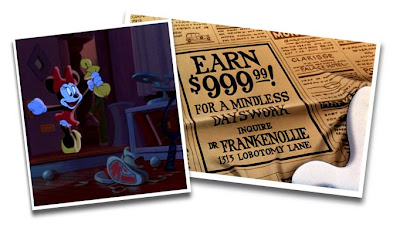
Preschooler moms beware--this is not your standard toddler-friendly Mickey Mouse cartoon. Hence its inclusion on a Disney Treasures DVD rather than in the more inclusive Cartoon Classics line. Modern audiences may be jarred somewhat by its darker, irreverent tone, but most animation buffs would likely view Runaway Brain as a return to Mickey’s earlier, often times impudent, sometimes scary, and definitely more uninhibited, black and white years.

Images © Walt Disney Company
Hawaiian Holiday - September 24, 1937

Even though it didn’t achieve statehood until 1959, the romance and exotic nature of Hawaii permeated stateside popular culture for much of the first half of the 20th century. It reached a crescendo of sorts just prior to World War II, and it was in this paradise-worshipping atmosphere that the 1937 Mickey Mouse cartoon Hawaiian Holiday was born.

Hawaiian Holiday likely owed some of its inspiration to another island-themed Hollywood production that preceded it into theaters by six months. The Bing Crosby musical Waikiki Wedding was a huge hit for Paramount Pictures, and featured the now classic tunes "Blue Hawaii" and the Oscar-winning "Sweet Leilani."

Hawaiian Holiday opens with the song "On the Beach at Waikiki," immediately establishing its exotic island setting. That famous tune by G. H. Stover and Henry Kalmai was one of the most popular songs of the 1930s and was introduced here by Mickey, Minnie, Donald and Goofy. Pluto was also on hand, rounding out one of the rare occasions when all of Disney’s “fab five” shared the screen in the same cartoon short.

We are quickly presented with many of the era’s romantic conventions of Hawaiian popular culture. The characters are enjoying a beachside luau. Mickey plays the traditional slack key guitar while Minnie and Donald alternate between ukulele strumming and hula dancing. In a distinct foreshadowing of his later Sport Goofy persona, the Goof engages in a pratfall-filled surfing vignette. At the time, surfing was still generally considered uniquely Hawaiian, and was just beginning to make its migration to places like Australia and California.

But alas, this many stars is two or three stars too many. Shortly after Mickey, Minnie and Donald are featured in a comical musical interlude, the rest of short settles into focusing mainly on Goofy with his surfboard and Pluto’s antics involving a crab and a starfish. This somewhat disjointed approach is fortunately offset by the short’s wonderful details (including outrigger canoe and little grass shack) and amazing watercolor backgrounds, both hallmarks of the Hyperion Avenue studio era.

One particular subtle and ongoing gag that I really enjoyed involved Goofy’s trademark hat. It is a well-crafted bit of plausible impossible. Despite pratfalls, high waves and underwater submersion, it, for the most part, remains firmly attached to its owner’s head. On the occasion when Goof and hat are separated, carefully orchestrated choreography reunites the two in short order.

Another subtle yet interesting detail is Minnie’s portrayal as a topless hula dancer. While replete with standard white gloves and oversize shoes, only a lei adorns her upper body. Sixty years later she would again travel to Hawaii at the conclusion of Runaway Brain, but would opt for a more conservative two piece suit for that trip.
Author DeSota Brown notes in the book Hawaii Recalls, “Films used Hawaii for all sorts of celluloid action, from tap dancing hula girls and angry volcanoes to murder mysteries and communist plots. These weren’t strictly intended to promote the islands as such, but they helped to do the job nonetheless. The fact that these movies were usually utterly unrealistic bolstered, instead of diminished, their selling abilities.”

To a similar extent, Hawaiian Holiday equally served to portray and promote that romantic notion of an unspoiled island paradise of a now bygone era, albeit in animated form.


Images © Walt Disney Company

A Visit to Dr. XXX

It is a near overwhelming task to quantify the sheer brilliance of the 1933 Mickey Mouse cartoon The Mad Doctor.

Director Dave Hand clearly intended to borrow style and design from that era's stark yet very stylized black and white horror films. This seven-minute tour de force is heavy on atmosphere and surprisingly, a little bit more chilling and unsettling than one might expect. So much so that it was considered unsuitable for some audiences by a British film censor, and later, 16mm prints carried a similar warning.

The Mad Doctor employs many standard horror story conventions, beginning with its dark and stormy night opening. It then goes on to blend three somewhat disparate themes--a haunted house filled with booby traps and secret passages, threatening creatures in the form of animated skeletons, and the title character mad doctor and his ambitious plans of body part amalgamation. Let's face it gang, those early Mickey cartoons were not the benign "strolling in the park one day" and "I'll clean up your yard" efforts that characterized his later Technicolor years.

The tone is established quickly when Pluto is violently kidnapped and taken to a skull rock-perched castle, the ominous and threatening features of which are only clearly revealed in split second lightening flashes. Mickey bravely follows in pursuit and quickly encounters the first in a series of comical yet still decidedly scary booby traps, when the castle bridge disassembles as he moves across it. Still teetering high above the crashing waves of the sea, Mickey is literally pulled into the castle's interior. At the same time, a nameplate near the door reveals the villain to be Dr. XXX. This is a distinct aside to Warner Brothers 1932 film Doctor X. That particular film's art direction and set design no doubt inspired Dave Hand and his crew as Mickey and Pluto's subsequent adventures would reveal.

Mickey finds himself in a set piece with all the standard haunted house embellishments. Cauldrons, chains and manacles, skulls and bones all litter the entrance foyer, while a swarm of bats emerge from the darkened recesses. Most striking is Mickey's journey down a secret passage that is, in my opinion, one of the single most amazing pieces of animation from those still rough-around-the-edges early days of cartoon production. In this sequence, as Mickey travels down a claustrophobic passage, the view follows him in a continuous shot as he pivots around a corner and tumbles down a long shaft. My young son, upon viewing this segment of the short, immediately exclaimed, "Wow, that was 3-D!" No, actually that was hand-drawn, traditional animation at its finest, where the background elements were ingeniously animated along with central character.

Following earlier efforts such as The Skeleton Dance and The Haunted House, the comical potential of skeletons is revisited again as Mickey encounters the prank-delivering undead denizens of the doctor's castle. It is here that the very clever designs of the creative team are entertainingly demonstrated, beginning with a coffin-styled cuckoo clock complete with skeletal cuckoo. Equally clever and well-realized is the skeleton-filled stairs that Mickey literally finds himself falling victim too. An ensuing chase scene in which the skeletons lob their own skulls at Mickey builds up the short's kinetic energy, but it's tempered somewhat by the still determined and resilient mouse's encounter with a giant spider skeleton.

At the same time, helpless victim Pluto is mired in troubles of his own. The mad doctor has revealed both himself and his diabolical plans. These plans involve Pluto and an equally terrified chicken and a lot of cutting and dissecting. The doctor's chalkboard diagrams are very funny as is his poetic soliloquy, but Pluto's fear in the scene is so palpable that the short does tangibly shift into a slightly more chilling and for some, no doubt frightening experience. When the mad doctor cuts apart Pluto's shadow, it is almost more disturbing than comical.

Despite his own valiant rescue efforts, Mickey soon finds himself in similar circumstances, and with no hope of escape. The story's happy resolution is only accomplished through the "it's all just a dream" plot device. But subtly, this underlying nightmare context is still a bit unsettling--the villain was never vanquished and the heroes were left to some decidedly grisly fates. I can see why some of those early card-carrying members of the theater-sponsored Micky Mouse Clubs may not have left the theater happily whistling "Turkey in the Straw."

But that was, and is still the joy of those early Mickey Mouse cartoons. Most of these endeavors displayed a plucky irreverence that was ultimately lost or diminished in later years. The Mad Doctor both immersed itself in, and at the same time, satirized Hollywood's then fledgling horror genre to great effect. It is certainly a classic piece of animation, and one of the most notable achievements of the Disney Studio's pre-Technicolor years.

This degree of notoriety served it well in recent years when it was used as the basis for content in the video game Mickey Mania: The Timeless Adventures of Mickey Mouse. Many of the short's inspired gags and pratfalls translated deftly into challenging game devices.

The Mad Doctor can be found on the Walt Disney Treasures DVD collection Mickey Mouse in Black and White Volume One.


Images from The Mad Doctor © Walt Disney Company